Loki Series - Alchemical Deification - Jung, Kingsley, von Franz, Evola, Grimes
This YouTube video analyzes the Marvel Disney+ series Loki through an esoteric and psychological lens, focusing on themes of alchemical deification and Jungian individuation. It explores Loki's transformation from villain to a cosmic deity, drawing parallels to ancient mystery traditions, alchemical symbolism, and the concept of the "trickster archetype." The video posits that Loki's journey mirrors an underworld initiation, leading to self-realization and a divine union of opposites, ultimately culminating in his becoming a benevolent "King of the World" at the center of the cosmos. The creator asserts that the series, especially its finale, visually and narratively reflects profound mystical and philosophical concepts related to time, eternity, and the nature of reality.
Marvel’s Loki Series
Summary Guide Materials for the video essay Loki and Alchemical Deification
This study guide is designed to help you review and deepen your understanding of the provided text, "Loki - Alchemical Deification - Jung, Kingsley, von Franz, Evola, Grimes."
Briefing
This briefing document reviews the main themes and most important ideas presented in the source "Loki - Alchemical Deification - Jung, Kingsley, von Franz, Evola, Grimes." The source argues that the Marvel Disney+ series Loki, particularly the arc from Thor 1 to Avengers 1 through the Loki series finale, is a "sci-fi fairy tale of alchemical transformation" leading to "alchemical deification." It draws parallels between Loki's journey and Jungian individuation, ancient mystery traditions, alchemical processes, and various mystical concepts, asserting that the show, whether intentionally or unconsciously, resonates with these esoteric themes.
Key Themes and Concepts:
1. Loki's Alchemical Deification and Jungian Individuation:
The central argument is that Loki's narrative arc mirrors the process of alchemical deification, which is the realization and becoming of the divine. This is closely tied to C.G. Jung's psychological alchemy and the concept of individuation.
Individuation as Deification: The source states, "This Disney Plus Marvel Loki streaming series tells a sci-fi fairy tale of alchemical transformation not just in the psychological sense of Jungian individuation and not just in the sense of spiritual redemption but alchemy as alchemical deification the process in which an individual comes to realize and become the divine." Jung's individuation is described as "the process of becoming fully realized as a human being," extending beyond psychological healing to a "deeper more profound significance." It can be argued that Jungian individuation is in some sense a deification process.
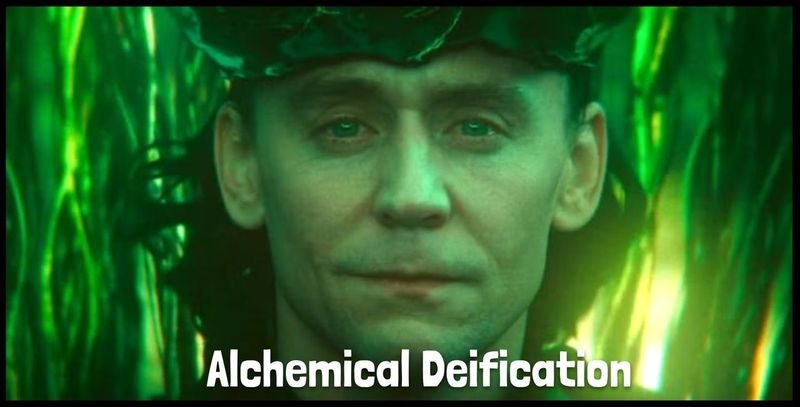
From Villain to Deified King: Loki begins as an "egotistical narcissist villain" but through his journey in the TVA (understood as an "afterlife journey of transformation" or "underworld journey/Katabasis"), he progresses to a "caring person capable of carrying a heavy burden for those he loves." This transformation culminates in him becoming a "sacrificial beneficent god king," replacing "He Who Remains" and embodying a "new kind of order in harmony with nature."
Alchemical Symbolism: The series is described as "jam-packed with alchemical symbolism marking Loki's process of individuation."
Persona and Shadow: Loki's "mask is that of an overconfident arrogant power-hungry prince," hiding his "shadow darkness" as a Frost Giant. His encounters with "shadow selves in the form of doppelgangers" force him to confront his "cringe-worthy aspects" and eventually realize his "desperate need for love validation and connection." "He Who Remains" is identified as the "primary shadow figure that Loki needs to contend with."
Anima/Animus and the Syzygy: The "game changer for Loki is meeting and making a genuine connection with his female variant Sylvie." Sylvie is Loki's "female variant," acting as his "conscience and as his pathway to empathy care and compassion for others." Their bond is described as "mysterium coniunctionis," a "transforming of the cosmos through the unification of the opposites anima and the animus," leading them to become the "syzygy."
The Self: Loki's ultimate redemption and transformation occur when he "consciously purposefully allows himself to lose the game he's been playing," dropping his "persona mask once and for all and realizes what Yung called the self the self is the center and wholeness of who we are." The climax of Season 2 is "chalk full of textbook archetypal imagery of the self."
The World Tree (Yggdrasil): Loki's sacrifice at the end of Season 2 "leads to the renewal of the world tree, the axis mundi and the entirety of the cosmos." Loki is seen "holding it all together at the roots," transformed into a "symbol of the self."
2. Underworld Journey and Mystery Traditions:
Loki's experience in the TVA is interpreted as an "underworld journey" or catabasis, akin to ancient mystery cult rituals.
Rehearsal of Death and Rebirth: The source explains that mystery cults involved "a ritual which people undergo a rehearsal of death in order to obtain eventually a better fate in the next world," influenced by ancient Egyptian religion. Loki's entry into a "limbo state" or "purgatory," his "forcibly pushed through a door of light" (a near-death experience trope), and his "life review" are all presented as parallels to these ancient practices.
Psychopomp: Mobius serves as Loki's "psychopomp," an "underworld figure who shows one the ropes." The name Mobius itself signifies "timeless infinity."
Initiation: Loki's "adventures in the TVA constitute such an initiation an initiation into mystery." This resonates with Plato's view of philosophy as "a preparation for death" and a path to "becoming godlike."
Egyptian Afterlife Journey: The source draws direct comparisons between Loki's journey and the Egyptian Dwat journey, where the dead journey through darkness, are transformed, and "arise again to start a new as Horus son of Osiris."
3. Trickster Archetype, Metis, and Divine Deception:
The source delves into Loki's identity as a trickster, exploring the deeper, divine implications of this archetype.
Trickster as Divine Force: Norse Loki, Coyote, Hū Coyōtl, and Prometheus are identified as representations of the trickster archetype. Unlike typical villainous interpretations, the source asserts that these figures "represent a vital aspect of the all powerful divine force of creation." It states, "the divine uses deception and the unsavory aspects of life to alert us to the secrets of God."
Apate and Maya: Loki's "illusion projection and duplication" are linked to the ancient Greek concept of apatate, a "primordial divine force of magical deception," and the Eastern idea of Maya, "the deceptive illusion stemming from the hidden power of creation."
Mercurius: This alchemical and hermetic figure, originating from the Greek god Hermes, is described as a "divine trickster" who "quickens alchemical transformation" and can "help one transform the mundane into the transcendent." Mercurius is seen as enabling Loki's transformation and as a "panacea savior and servitor mundi preserver of the world."
Metis (Cleverness): Peter Kingsley's concept of metis is introduced as a "form of consciousness that is fully alert aware and clever" that "detects deception [and] allows for us to navigate the tricks by becoming a trickster ourselves." He Who Remains is lauded for his superior metis, while Loki's journey involves learning and mastering this quality.
Cosmos as a Trick: The ultimate revelation is that "the whole cosmic fabric of creation is a trick." The world of multiplicity, distinction, and time is an "illusion" or "artistic illusion" (Plato).
4. Love, Strife, and the Nature of Reality:
The source explores the interdependent relationship between love and strife, drawing from Empedocles and other ancient thinkers, to explain the creation and nature of the cosmos.
Interdependent Divine Forces: Love and strife are presented not as simply good/bad or positive/negative, but as "divine and interdependent," like "the sides of the Mobius strip or four-dimensional klein bottle and like yin and yang love and strife go with each other both are dynamic modes of the divine."
Strife Creates Distinction and Time: "Strife isn't necessarily something that is morally or ethically bad strife is what makes distinction possible... without strife love merges all things into a distinction less amorphous sphere." Time is described as being created by strife: "strife through fostering disorder in the cosmos and distinction between things creates what we call time in love's unity there is no time strife creates time."
Cosmic Play (Leela): The interplay of love and strife enables the "divine play that some Hindu traditions call leela," as "for love to function as a verb as an action it requires two or more if strife were abolished the world would cease to exist."
Suffering as a Catalyst: Suffering, brought about by strife, "allows us to see that strife separation distinction disruption disorder is unpleasant but it is an opportunity nonetheless." It's not about escaping suffering, but "to suffer consciously."
Kali as Embodiment: The Hindu goddess Mahakali is presented as embodying "the dynamic interplay of love and strife the forces of combination separation and reformation."
5. Aion and the Timeless Eternal:
The source distinguishes between chronological time (Kronos) and Aion, the timeless, eternal reality, arguing that Loki's transformation is into Aion.
Aion vs. Kronos: Kronos is "chronological time," while Aion is "what is beyond time the timeless eternal depths in which time plays out." Aion is "always being or everexisting or for all time."
The TVA as a False Aion/Demiurge: The TVA, created by He Who Remains, is described as a "false ion run by fake divinities," functioning more like a demiurge that projects an imperfect, illusory world of chronological time.
Loki Becomes Aion: At the end of the series, Loki is "Loki at the end of the series looking at this from a mystical and alchemical perspective Loki becomes an archetypal representation of the ancient timeless one behind time loki is for all time always loki is ion." This links to Jung's own experience of becoming Aion as documented in his Red Book.
"Time-Slipping" as Rooting in Eternity: Loki's mastery of "time-slipping" is reinterpreted as "planting himself in the timeless," a "purposeful act of navigation" that roots him "in the realm of the eternal." This is analogized to "sacred agriculture," becoming "farmers and planters of eternity inside us."
6. Sacred Masculine, Sacred Feminine, and Sacred Agriculture:
The source addresses the interplay of masculine and feminine principles and links it to ancient agricultural practices.
Honoring the Feminine: For the "masculine to become sacred it must paradoxically be rooted in the sacred feminine." Loki's refusal to kill Sylvie and his act of deep compassion are presented as "honoring the sacred feminine," which then allows him to "take ultimate responsibility" (sacred masculine).
New Order through Receptivity: Loki achieves his "throne as king of the world" not through "patriarchal domination" but through "receptivity and sacrifice of ego," becoming a "powerful symbol of taking ultimate responsibility."
Gardening as a Sacred Practice: The transformation is likened to "sacred agriculture," where "real spiritual work means becoming gardeners." This draws on ancient traditions where gardening was a "sacred context" and links to figures like Osiris (vegetation god) and the "Tree of Life."
Conjunction of Opposites: The ultimate goal is the "sacred union of the opposites awakened observation of the present moment is itself hieros gamos divine sexual union." This refers to the union of the "motionless everpresent called the eternal and the illusory moving images called time."
Most Important Ideas/Facts:
Loki's Arc as a Deification Narrative: The core thesis is that the Loki series, intentionally or not, depicts a profound spiritual journey of a character becoming divine, mirroring alchemical and mystical processes.
Jungian Individuation Beyond Psychology: The source emphasizes that Jung's individuation is not merely about self-improvement or societal adjustment but a process of spiritual transformation and deification, a point often overlooked by mainstream psychology.
The Cosmic Trick: The idea that all of manifested reality, including time and distinction, is a divine illusion or "trick" (Maya, Apatate) is a foundational concept presented, and understanding this deception is key to awakening.
Interdependence of Love and Strife: Love and Strife are not opposing moral forces but dynamic, interdependent principles essential for creation, distinction, and the very existence of time.
Aion as True Eternity: The distinction between chronological time (Kronos) and timeless eternity (Aion) is crucial. Loki's journey is presented as a transformation into Aion, the eternal observer at the cosmic center.
Sacred Agriculture and Embodied Eternity: The novel connection between Loki's "time-slipping" and the ancient practice of "sacred agriculture" highlights the idea of rooting oneself in the eternal present through sensory awareness and stillness.
The Watcher and the Watched as God: The ultimate realization presented is that "the conjunction of the watcher and the watched is God god is a verb," an "alert awareness" that is a "sacred union of the opposites." This is the "good news," accessible through conscious sensory engagement and quiet stillness.
In essence, the briefing argues that Loki provides a modern framework for understanding ancient esoteric paths of deification, emphasizing the transformative power of confronting one's shadow, embracing connection, understanding the illusory nature of reality, and ultimately, sacrificing the ego to become a compassionate, eternal guardian of creation.
I. Core Concepts and Themes
The central argument of the text is that the Marvel Cinematic Universe (MCU) Loki's journey, particularly from Thor 1 to Avengers 1 and through Loki Season 1 and 2, can be interpreted as a sci-fi fairy tale of alchemical deification. This deification is understood not merely in a psychological sense (Jungian individuation) or spiritual redemption, but as a process where an individual realizes and becomes the divine.
Key themes explored include:
Alchemy and Deification: The core idea that Loki's transformation mirrors alchemical processes, leading to a realization of his inherent divinity. This includes both Jung's psychological alchemy and ancient mystery traditions.
Underworld Journey/Catabasis: Loki's time in the TVA is presented as an "afterlife journey of transformation," analogous to ancient mystery cult rituals involving a rehearsal of death for a better fate.
Jungian Individuation: Loki's character arc from an egotistical narcissist to a caring, self-sacrificing being is framed as a process of individuation, involving confrontation with the persona, shadow, anima/animus, and ultimately the Self.
The Trickster Archetype: Loki's traditional role as a trickster is re-examined, suggesting that trickery, deception, and "strife" (as per Empedocles) are divine forces necessary for creation, distinction, and ultimately, awakening.
Love and Strife: These ancient Greek concepts are presented not as binary opposites of good and evil, but as interdependent, dynamic modes of the divine, both essential for the "divine play" (leela) of existence and the creation of time and distinction.
Time and Eternity (Kronos vs. Aion): The distinction between chronological, linear time (Kronos) and timeless, eternal being (Aion) is crucial. The TVA is presented as a false Aion, an illusion of order, which Loki transcends to become the true, eternal Aion.
Sacred Agriculture and Embodied Awareness: The text connects ancient agricultural practices to the origins of religious belief and the concept of "sacred farming" – a process of rooting oneself in the eternal present through sensory engagement and still observation, leading to self-realization and a "new earth."
The King of the World/Anthropos: Loki's final transformation into the "Green Man" at the center of the cosmos, holding the timelines together, is linked to the ancient motif of the "King of the World" or the "Anthropos" – a divine primordial human encompassing the entire cosmos.
The Grail Quest: Loki's journey is compared to the Grail quest, where the "Citadel at the End of Time" functions as the Grail Castle, and Loki's refusal to kill Sylvie represents his ultimate alchemical purification and true initiation.
II. Key Figures and Their Contributions
C.G. Jung: His concepts of psychological alchemy, individuation, the unconscious, archetypes (persona, shadow, anima/animus, Self), and the idea of individuation as deification are central.
Marie-Louise von Franz: Jung's protégé, her work on underworld narratives, alchemical symbolism, and the individuation process (especially in relation to the tree symbol) is frequently cited.
Peter Kingsley: An academic turned esoteric teacher, Kingsley's emphasis on Jung's metaphysical aspects of individuation (deification), the ancient Greek concept of metis, and the figure of Aion are prominent.
Julius Evola: A controversial esotericist, his views on alchemy as a "royal art" for human and natural transformation, and his connection of alchemical symbolism to transcendence and the "absolute individual," are introduced.
Shannon Grimes: Her work on the ouroboros and hermetic alchemy, particularly the concept of "sacred art" and the manufacturing of divine statues, informs the discussion.
Empedocles: The ancient Greek philosopher whose ideas on "love and strife" as divine forces creating the world of distinction are elaborated upon.
Heraclitus & Parmenides: Other pre-Socratic philosophers whose ideas on the illusory nature of the manifest world and the underlying oneness are referenced.
Richard Seaford: His definition of ancient mystery cult rituals provides a framework for understanding Loki's underworld journey.
Alan Watts: His discussion of "somethingness and nothingness" is used to illuminate the interplay of love and strife.
Meister Eckhart: The Christian mystic whose teachings on giving birth to God within oneself and the "sacred field" are used to connect to sacred agriculture.
Valentinus: The Gnostic Christian teacher whose concept of God as a "dyad" (deep father and silent womb mother) is presented as an ancient parallel to the interplay of opposites.
Guénon, René: His motif of the "King of the World" as a unifying figure overseeing physical and metaphysical realms is connected to Loki's final role.
III. Important Terms and Concepts
(See Glossary for detailed definitions)
Alchemy
Alchemical Deification
Individuation
Persona
Shadow
Anima/Animus
Syzygy
Self
Catabasis/Underworld Journey
Psychopomp
Mobius Strip/Klein Bottle
Mysterium Coniunctionis
Metis
Apatate
Maya
Ouroboros
Love and Strife (Empedocles)
Leela (Divine Play)
Kronos
Aion
Demiurge
Theophany
Anthropos
Green Man
Khadir
Sacred Agriculture/Eoteric Farming
Books of Breathing
Pasa
Dharshan
Muraqaba
Hieros Gamos
King of the World
Holy Grail/Grail Castle
Royal Art
Hermeticism
Gnosis
Prakriti
Purusha
Critical Thinking and Discussion Points
Intentionality vs. Unconscious Resonance: The text suggests some themes in Loki are intentional, while others are shaped by the unconscious. How does this distinction influence the interpretation of the series?
Pop Culture as Esoteric Text: The author uses a Disney+ Marvel series as a "jumping-off point" for deep esoteric discussion. What are the implications and potential challenges of finding profound meaning in popular entertainment?
Jung's "Secret": The idea that Jung's later work on individuation was a process of deification, kept "secret" or downplayed for scientific acceptance, is a significant claim. How does this reframe Jungian psychology?
Reconciling Opposites: The recurring theme of unifying opposites (male/female, love/strife, order/chaos, time/eternity) is central. How is this reconciliation depicted in Loki's journey, and what does it signify in the broader esoteric context?
The Nature of Reality as a "Trick": The idea that the cosmos, distinction, and time itself are "illusions" or "tricks" is a profound philosophical and mystical statement. How does the text use examples (Coca-Cola pixels, trickster figures) to convey this?
Suffering and Transformation: The text emphasizes suffering as a necessary component of transformation, not something to escape. How does Loki's experience align with this view, and what is the role of "conscious suffering"?
The "Trick" of the Video Itself: The author explicitly states the video is "clickbait" and a "trick" about the viewer's present moment. How does this meta-commentary reinforce the themes of deception, awareness, and direct experience?
V. Quiz
Instructions: Answer each question in 2-3 sentences.
What is the primary argument the author makes about the Loki streaming series in relation to esoteric ideas?
How does the author interpret Loki's time in the TVA, and what ancient concept does it resemble?
Explain how Loki's character arc is connected to C.G. Jung's concept of individuation.
According to the text, what is the significance of Loki's bond with Sylvie in his journey?
How do the ancient Greek concepts of "love" and "strife" (from Empedocles) apply to the cosmic order discussed in the text?
Distinguish between Kronos and Aion as presented in the study material, and explain which one the TVA embodies.
What does the author mean by "sacred agriculture" or "esoteric farming," and how is it related to Loki's mastery of "time-slipping"?
How does the text link Loki's final transformation to the ancient motif of the "King of the World" or the "Anthropos"?
What is the paradoxical nature of suffering as discussed in the context of Peter Kingsley's interpretation of Jung?
The author reveals the video itself is a "trick." What deeper message is this meta-commentary intended to convey to the viewer?
VI. Quiz Answer Key
The primary argument is that the Loki series tells a sci-fi fairy tale of alchemical deification. This process involves the individual coming to realize and become the divine, drawing parallels to C.G. Jung's psychological alchemy and ancient mystery traditions.
The author interprets Loki's time in the TVA as an "afterlife journey of transformation," specifically an underworld journey or catabasis. This resembles ancient mystery cult rituals where individuals undergo a rehearsal of death to achieve a better fate in the next world.
Loki's character arc mirrors Jungian individuation by showing his progression from an egotistical narcissist to a caring, self-sacrificing individual. This involves confronting his persona, integrating his shadow aspects (doppelgangers, He Who Remains), and forming a crucial connection with his anima figure (Sylvie).
Loki's bond with Sylvie is presented as the "game changer" that leads to his full individuation. Sylvie serves as his conscience and pathway to empathy, care, and compassion, allowing him to love others more than himself and ultimately leading to his deification.
Love and strife are depicted as interdependent, dynamic modes of the divine, not merely good and bad. Strife enables distinction, creating boundaries and the perception of individual things, thus preventing stagnation and allowing for the "divine play" (leela) of the cosmos.
Kronos represents chronological, linear time, which we use daily, while Aion represents timeless, eternal depths, where past, present, and future are one. The TVA, despite its slogan, functions as a false Aion, a deceptive, static cosmic craftsman or demiurge trying to impose an artificial order.
"Sacred agriculture" or "esoteric farming" refers to the practice of rooting oneself into the eternal present moment through conscious sensory engagement and quiet stillness. Loki's mastery of "time-slipping" becomes an analog for this, as he purposefully plants himself in the timeless realm through deep breathing and focused awareness.
Loki's final transformation into the "Green Man" at the center of the cosmos, holding the timelines, is linked to the ancient motif of the "King of the World" or "Anthropos." This figure represents a divine, primordial human being who encompasses the entire cosmos and unifies physical and metaphysical realms.
The paradoxical nature of suffering is that it is not something to be escaped, but rather an opportunity for profound insight. According to Kingsley's interpretation of Jung, suffering, particularly "conscious suffering," allows one to see through the illusions of distinction, time, and space, enabling the recognition of immortality and divinity.
By revealing the video is a "trick," the author aims to emphasize that the true subject is the viewer's immediate, embodied experience in the present moment. This meta-commentary reinforces the idea that reality itself is a "trick" or illusion that demands participation, and true awakening comes from direct, sensory observation of this interplay.
VII. Essay Format Questions
Discuss how the Loki series, as interpreted in the text, utilizes the journey motif, particularly the "underworld journey" or catabasis, to depict a process of profound transformation. Analyze specific plot points and character experiences that align with this ancient concept.
Explore the multifaceted role of the "trickster" archetype in the provided text. How does the author redefine Loki and other trickster figures (like Coyote or Prometheus) beyond mere mischief-makers, and what is their essential function in the process of alchemical deification and cosmic creation?
Analyze the interplay between "love" and "strife" as presented in the text, drawing connections to Empedocles and other philosophical or mystical traditions. How do these seemingly opposing forces contribute to the "divine play" and the manifestation of reality, and how does Loki embody this dynamic?
The text argues that C.G. Jung's concept of individuation extends beyond mere psychological self-improvement to a process of "deification." Based on the provided material, explain the distinction between these two understandings of individuation, providing examples from Loki's journey to illustrate this deeper, mystical dimension.
Discuss the significance of "time" and "eternity" in the Loki series' interpretation, differentiating between Kronos and Aion. How does Loki's mastery of "time-slipping" and his eventual role at the center of the world tree represent a transcendence of Kronos and an embodiment of Aion, aligning with the concept of "sacred agriculture"?
VIII. Glossary of Key Terms
Alchemy: An ancient practice and philosophy concerned with the transformation of matter, often metals into gold, but also interpreted as a metaphor for spiritual and psychological transformation.
Alchemical Deification: The process, as interpreted in the text, where an individual undergoes a profound transformation, similar to alchemical processes, leading to the realization and embodiment of their inherent divine nature.
Anima/Animus: In Jungian psychology, these are archetypes representing the unconscious feminine aspects in a man (anima) and masculine aspects in a woman (animus). Their integration is crucial for individuation.
Anthropos: An ancient archetypal image of a divine, primordial human being who encompasses the entire cosmos, often depicted as a conjunction of opposites (masculine/feminine, material/non-material).
Aion: In ancient Greek philosophy, Aion represents eternal time, or timeless eternity – an unchanging, ever-present reality that is beyond chronological measurement (Kronos).
Apatate: An ancient Greek term referring to deception or magical illusion, which in some traditions was considered a primordial divine force.
Archetype: In Jungian psychology, a specific node of energy within the unconscious mind that manifests as universal patterns, images, or motifs in human experience, mythology, and dreams.
Axis Mundi: A universal symbol representing the center of the world, connecting heaven, earth, and the underworld (e.g., the World Tree, a mountain, or a column).
Books of Breathing: Ancient Egyptian funerary texts that helped guide the deceased through the afterlife journey, teaching them to breathe eternally and become divine.
Catabasis: An underworld journey or descent, a common motif in mythology and mystery traditions where a hero or initiate descends into the realm of the dead or unconscious for transformation.
Demiurge: In some ancient Greek and Gnostic philosophies, a cosmic craftsman or creator god who shapes the material world, often seen as imperfect or illusory, from pre-existing matter, rather than creating it ex nihilo.
Dharshan: In Hindu traditions, a moment of divine sight, grace, or blessed vision experienced by a devotee when in the presence of a deity, guru, or sacred object.
Gnosis: Direct, experiential knowledge of divine truths, often revealed through mystical experience or initiation, as opposed to intellectual understanding.
Grail Castle: A legendary castle in Grail narratives, often described as invisible and unreachable, existing in a cosmic realm outside normal time and space, guarding the Holy Grail.
Green Man: A motif found in many cultures, often depicted as a face surrounded by or made of foliage, symbolizing nature, death, fertility, rebirth, and a transcendent figure connected to the secrets of nature.
He Who Remains: The character in Loki who created and controls the TVA, representing a patriarchal, controlling force that imposes a singular, linear timeline.
Hermeticism: An esoteric tradition rooted in texts attributed to Hermes Trismegistus, teaching divine knowledge (gnosis) and practices for spiritual and material transformation.
Hieros Gamos: A "sacred marriage" or divine sexual union, often symbolizing the mystical union of cosmic opposites (e.g., heaven and earth, masculine and feminine principles).
Individuation: In Jungian psychology, the lifelong process of becoming a fully realized, integrated human being, achieving wholeness by integrating conscious and unconscious aspects of the psyche, which the text argues is a process of deification.
Khadir (Al-Khadir): A venerable figure in Islam, often associated with a "green" appearance, believed to be an immortal guide for spiritual seekers, sometimes characterized as a trickster who teaches through unexpected methods.
King of the World: A motif found in various religious and esoteric traditions, referring to a unifying figure who sits at the center of the cosmos, overseeing both physical and metaphysical realms, and providing renewal.
Klein Bottle: A non-orientable topological space, a four-dimensional analog of the Mobius strip, used in the text as a metaphor for the inseparable nature of yin and yang or love and strife.
Kronos: The ancient Greek god of time, often associated with chronological, linear, measurable time, in contrast to Aion (timeless eternity).
Leela (Lila): A Hindu concept referring to the "divine play" or cosmic dance of creation, preservation, and dissolution, suggesting that the universe is a spontaneous, joyful activity of the divine.
Love and Strife: Concepts from the ancient Greek philosopher Empedocles, seen not as moral good/evil, but as fundamental divine forces. Love brings things together into unity, while Strife separates and creates distinction, both necessary for existence.
Maya: In various Eastern traditions (e.g., Hindu, Buddhist), the illusory or deceptive nature of the manifested world, stemming from the hidden power of creation, often associated with a hidden creative feminine principle.
Mercurius: A revered figure in hermetic and alchemical traditions, originating from the Greek god Hermes, understood as a divine trickster and alchemical solvent that quickens transformation, often equated with the Christ figure in some alchemical texts.
Metis: An ancient Greek term for a form of consciousness that is fully alert, aware, and clever, capable of detecting and navigating deception by becoming a trickster oneself.
Mobius Strip: A single-sided, single-edged surface, used as a metaphor for the inseparability of seemingly opposite concepts (e.g., yin and yang, love and strife).
Muraqaba: A Sufi meditation practice rooted in the Arabic word for "watching" or "guarding," aimed at achieving transcendent union with the divine through quiet observation.
Mysterium Coniunctionis: Latin for "mystery of the conjunction," a central alchemical concept referring to the union of opposites, particularly the masculine and feminine principles, leading to profound transformation.
Ouroboros: An ancient circular symbol depicting a serpent devouring its own tail, representing cyclicality, eternal recurrence, unity, infinity, and regeneration; a key symbol in alchemy and hermeticism.
Pasa: In Buddhist discourse, the "contact" or "link" between attention and sensory experience, crucial for experiencing the present moment directly through the body.
Persona: In Jungian psychology, the social mask or outward identity that an individual presents to the world, often developed during upbringing within societal norms.
Psychopomp: A mythological figure or guide who conducts souls to the afterlife or through an underworld journey (e.g., Mobius for Loki).
Royal Art: A term used by esotericists like Julius Evola to refer to alchemy, emphasizing its capacity to transform the individual into a transcendent, god-like state.
Sacred Agriculture/Esoteric Farming: The concept that ancient agricultural practices were sacred and linked to religious beliefs, and, metaphorically, the spiritual practice of cultivating eternity within oneself through embodied awareness and sensory engagement.
Self (Jungian): The archetype of wholeness and totality in Jungian psychology, representing the unified conscious and unconscious psyche; the ultimate goal of individuation, often associated with the "God-image" within.
Shadow: In Jungian psychology, the unconscious aspects of the personality that are repressed or denied by the conscious ego, often seen as undesirable or darker traits, but also containing creative potential.
Strife: (See "Love and Strife")
Syzygy: A Jungian term referring to a pair of opposites that are joined together, particularly the anima and animus, whose union can lead to transformative power.
Theophany: The visible manifestation of a deity to human beings, or the human perception of divine images.
Time Variance Authority (TVA): The bureaucratic organization in the Loki series that manages the "Sacred Timeline," depicted in the text as a "limbo state" or "purgatory," and a false representation of Aion.
Trickster Archetype: A universal mythological figure who challenges rules, disrupts order, and often uses deception, but whose actions can paradoxically lead to creation, renewal, or awakening.
Underworld Journey: (See "Catabasis")
Yin and Yang: In Chinese philosophy, two complementary, interconnected, and interdependent forces that describe how seemingly opposite or contrary forces may actually be interconnected and interdependent in the natural world.
FAQ
1. How does the Loki series serve as a narrative for alchemical transformation and deification?
The Loki series, particularly from Thor 1 through the end of Loki Season 2, presents a narrative of alchemical transformation and deification, not just in the Jungian psychological sense of individuation but as a process where an individual realizes and becomes divine. This journey is likened to ancient mystery traditions involving an "underworld journey" or "catabosis," where Loki, initially a defeated villain, enters a limbo state (the TVA) akin to purgatory or an afterlife. His experiences in the TVA, including a "life review" and guidance from a "psychopomp" (Mobius), mirror ancient initiation rituals where individuals rehearse death to achieve a better fate in the next world. The show's progression of Loki from an egotistical narcissist to a caring, self-sacrificing figure embodies Jung's individuation process, culminating in a mystical "alchemical deification" where he transcends personal healing to become a cosmic, divine being, embodying the "Self."
2. What role do Jungian concepts like the "persona," "shadow," and "anima/animus" play in Loki's transformation?
Loki's journey is deeply intertwined with Jungian concepts. His initial state is defined by his "persona" – the overconfident, arrogant, power-hungry prince who constantly schemes and hides his true identity as a Frost Giant. This persona masks a "shadow," representing the undesirable aspects of his personality and his desperate need for worldly power and adoration, which he confronts through encountering his "shadow selves" or "doppelgangers." The turning point for Loki is his genuine connection with Sylvie, his female variant, who functions as his "anima." This "mysterium coniunctionis" (unification of opposites) allows Loki to develop empathy, care, and compassion, ultimately leading him to prioritize the well-being of others over his own power. Sylvie's "stubborn, unwavering stance" (representing yin energy) and Loki's newfound compassion guide him to a selfless path, moving beyond heroic, forceful (yang) approaches.
3. How does the concept of "strife" as a divine force contribute to the cosmic understanding presented in the sources?
"Strife," often misunderstood as solely negative, is presented as a primordial divine force, a counterpart to love, and essential for creation and distinction. Drawing from ancient Greek thinkers like Empedocles, the sources explain that strife is what makes distinction possible, preventing everything from merging into an undifferentiated amorphous sphere. It creates boundaries and the perception of individual things, allowing for contrast. In the Loki series, characters like Loki, Sylvie, and He Who Remains embody this principle of strife, disrupting the status quo and fostering disorder. This "disorder" is paradoxically always in service of eternal unity, enabling the "divine play" (leela) and the renewal of the cosmos. Without strife, there would be no separation, no time, and no awareness of "one" through distinction.
4. What is the significance of the "trickster" archetype in Loki's journey and in broader esoteric traditions?
The "trickster" archetype, epitomized by figures like Norse Loki, Coyote, and Prometheus, represents a vital aspect of the divine force of creation. These figures use deception and unsavory aspects of life to reveal deeper truths. In the Loki series, Loki himself is a trickster, initially using "illusion projection and duplication" (apatate), a form of magical deception akin to the Eastern concept of Maya (deceptive illusion). The journey reveals that the entire cosmic fabric is a trick, and by developing "metis" (a form of clever, alert consciousness), one can navigate these illusions and even become a trickster oneself to awaken to reality. Loki, despite his villainous beginnings, never fully loses his connection to deeper divinity, eventually seeing through the cosmic trickster's ways to find his true purpose outside of linear causality.
5. How is the idea of "time" redefined in the context of alchemical and mystical transformation, particularly with "Aion"?
The Loki series challenges conventional understandings of time. The TVA, initially presented as a controller of "chronological time" (Kronos), is revealed as a "false Aion" or "demiurge," an illusion of motion projected from an unmoving eternity. Loki's "time slipping" initially chaotic and painful, transforms into a purposeful act of navigating the timeless. This mastery of time is linked to "Aion," a representation of what is beyond linear time – "the timeless eternal depths in which time plays out." By rooting himself in the "eternal," Loki transcends chronological time, becoming "Aion" himself, an archetypal representation of the "timeless one behind time," akin to the Buddhist concept of being "free from time."
6. What is the symbolic meaning of Loki becoming the "World Tree" or "Axis Mundi" at the end of the series?
Loki's ultimate transformation culminates in him becoming the "World Tree" or "Axis Mundi," a powerful image representing the center of the cosmos found in various ancient cultures like Norse (Yggdrasil). This imagery symbolizes the "opus alchemical" and the individuation process. Loki's self-sacrifice at the end of Season 2 leads to the renewal of the world tree, holding all of existence together at its roots. This signifies his complete transformation from an egotistical mischief-maker into a symbol of the "Self" – the center and wholeness of being. He becomes the "Green Man," a transcendent figure embodying nature, death, fertility, and rebirth, providing a new kind of order in harmony with nature, unlike the controlling dominance of He Who Remains.
7. How do ancient agricultural practices and the concept of "sacred farming" relate to the themes of transformation and eternity?
Ancient agricultural practices are deeply intertwined with concepts of time, religious beliefs, and spiritual transformation. The idea of "sacred farming" is presented as a metaphor for cultivating eternity within oneself. Loki's mastery of "time slipping" is likened to "planting himself in the timeless" or "rooting oneself into the present moment through the body's sensory system." This practice, reminiscent of breath-based meditations, allows one to embody the true present moment, leading to the realization that sensation itself is eternal and timeless. Through "conscious attention" and "still embodied observation," individuals can "take the fruit of our finite life... and transform it with the alchemy of our conscious attention and offer it back to the divine as a part of divine realization." This transforms the mundane into a "new earth," where individuals become "vessels of creation" and "the tree of life."
8. What is the ultimate "trick" revealed by the sources, and how does it relate to the nature of reality and the divine?
The ultimate "trick" revealed is that what we experience as reality, including distinct senses, time, and space, is an "illusion of multiplicity," a "world-creating trickery" or "divine play" (leela). Drawing from philosophers like Plato and Parmenides, the sources suggest that the ultimate truth is "one," and the world of separation is a deception necessary for comprehension and dynamic existence. Loki's journey, filled with trickery, eventually leads him to "see through the ways of the cosmic trickster" and realize that his "true glorious purpose cannot be found within the world of creation causality, time, and space." The video itself is presented as a "trick" to highlight that the deepest alchemy and divine realization occur through direct, embodied experience of the present moment – the "conjunction of the watcher and the watched is God," a dynamic interplay between observation and creation.